

As a PhD student at the University of Cape Town’s (UCT) African Centre for Cities, Saratu Mshelia’s work has primarily focused on democratic innovation and how grassroots communities use modern technologies to mobilise their causes.
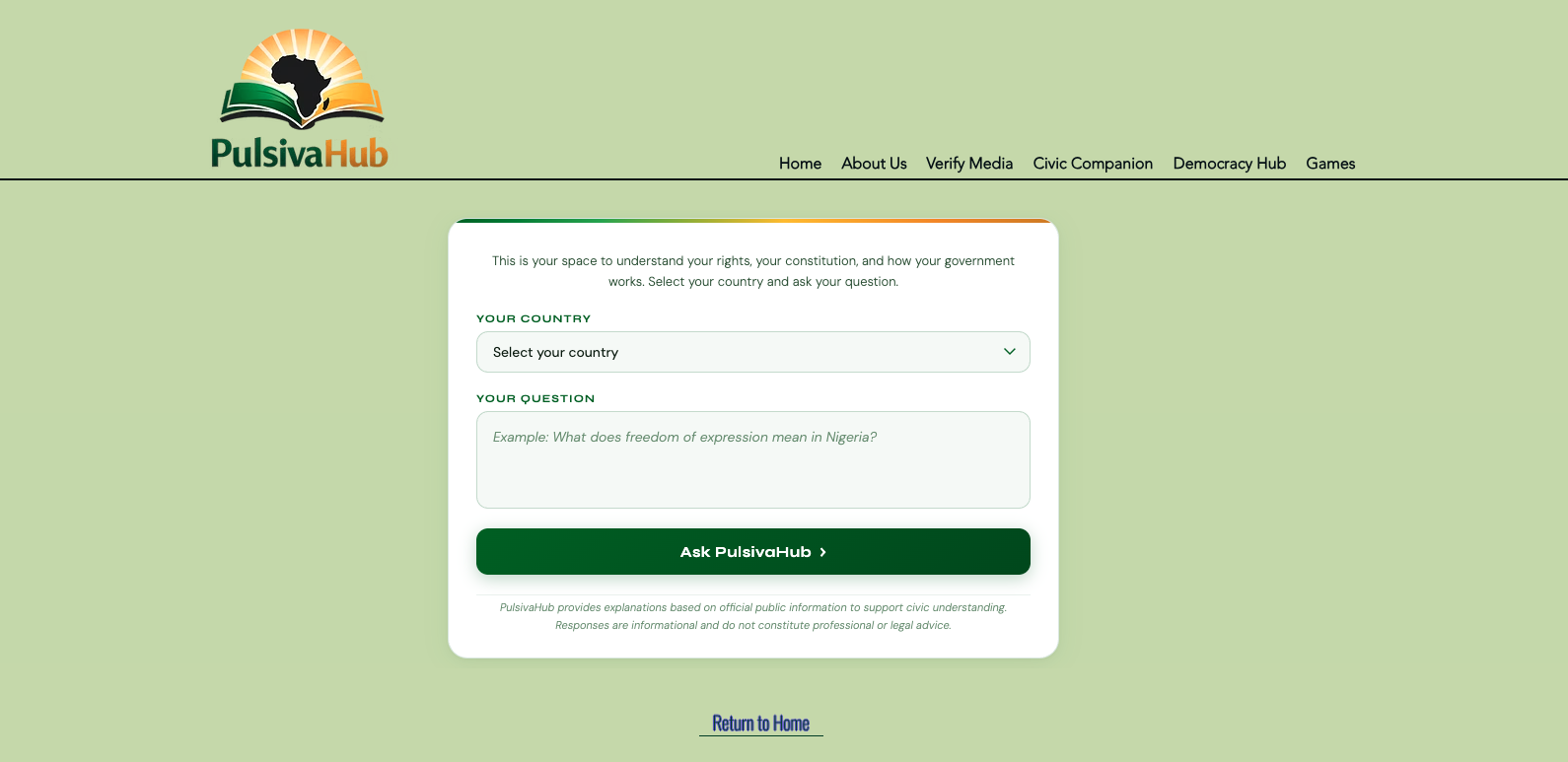
Through her academic experience and ongoing research, Mshelia was inspired to start PulsivaHub, which she describes as an AI-powered civic companion that aims to empower citizens through accessible civic education and the ability to navigate the increasing reach of AI-manufactured content in the civic space.
PulsivaHub bridges two key issues that Mshelia has identified in her work, namely a lack of constitutional literacy in everyday life, and the risks that AI-generated content poses to democratic environments.
“My personal experience is that constitutional literacy is not really a priority in practice,” says Mshelia. “A lot of us go most of our lives without ever engaging with or having even read the Constitution, and so it begs the question: If you don’t know the rule book, how are we expected to be better or more informed citizens?”
The platform creates a safe, online environment where users can submit any queries they may have regarding their country of residence’s constitution and expect informative, plain-language answers – completely anonymously. Users can currently choose from 13 African countries, but Mshelia aims to integrate the constitutions of all 54 sovereign African countries into the system.
“We envision it to be a pan-African project,” she says. “But of course, with country-specific depth.”
PulsivaHub can also be used to verify whether a submitted image is genuine or AI-manipulated. Mshelia says that the irony of using an AI-powered platform to counter the impact of AI in civic and political environments is not lost on the PulsivaHub team, but that it is important to keep in mind that AI has both risks and potential benefits.
“Both can be true at the same time,” she says. “So for us, it’s about leveraging AI to empower citizens to counter the contemporary issues that technology also brings.”
With support from the Digital Democracy Innovation in Sub-Saharan Africa (DDISA) Fund, PulsivaHub aims to add WhatsApp integration to the civic companion, making it more easily accessible for a larger variety of communities. According to Mshelia, PulsivaHub has benefitted greatly from the support DDISA has been able to provide, including the non-financial support.
“There is a need for support for emerging, small projects like mine because everybody starts from somewhere,” she says. “We need to speak to other civic organisations. We need to share experiences.”
Looking to the future, PulsivaHub hopes to develop their own AI and data infrastructure that is native to the African continent and therefore not reliant on Western-based resources.
“We ask, what if something happens tomorrow that cuts your access to these tools and to these projects that we’re connecting with?” Mshelia says. “Alongside the civic companion, we are building what we call the Civic Media Intelligence, the CMI. But it’s a long-term vision.”
As PulsivaHub grows, the question that first inspired the project remains central: How can citizens hold power to account if they don’t know the rules? With a WhatsApp integration in development and more constitutions to add, Mshelia hopes to bring that knowledge within reach of communities across the continent.